1.3. – 24.5.2026
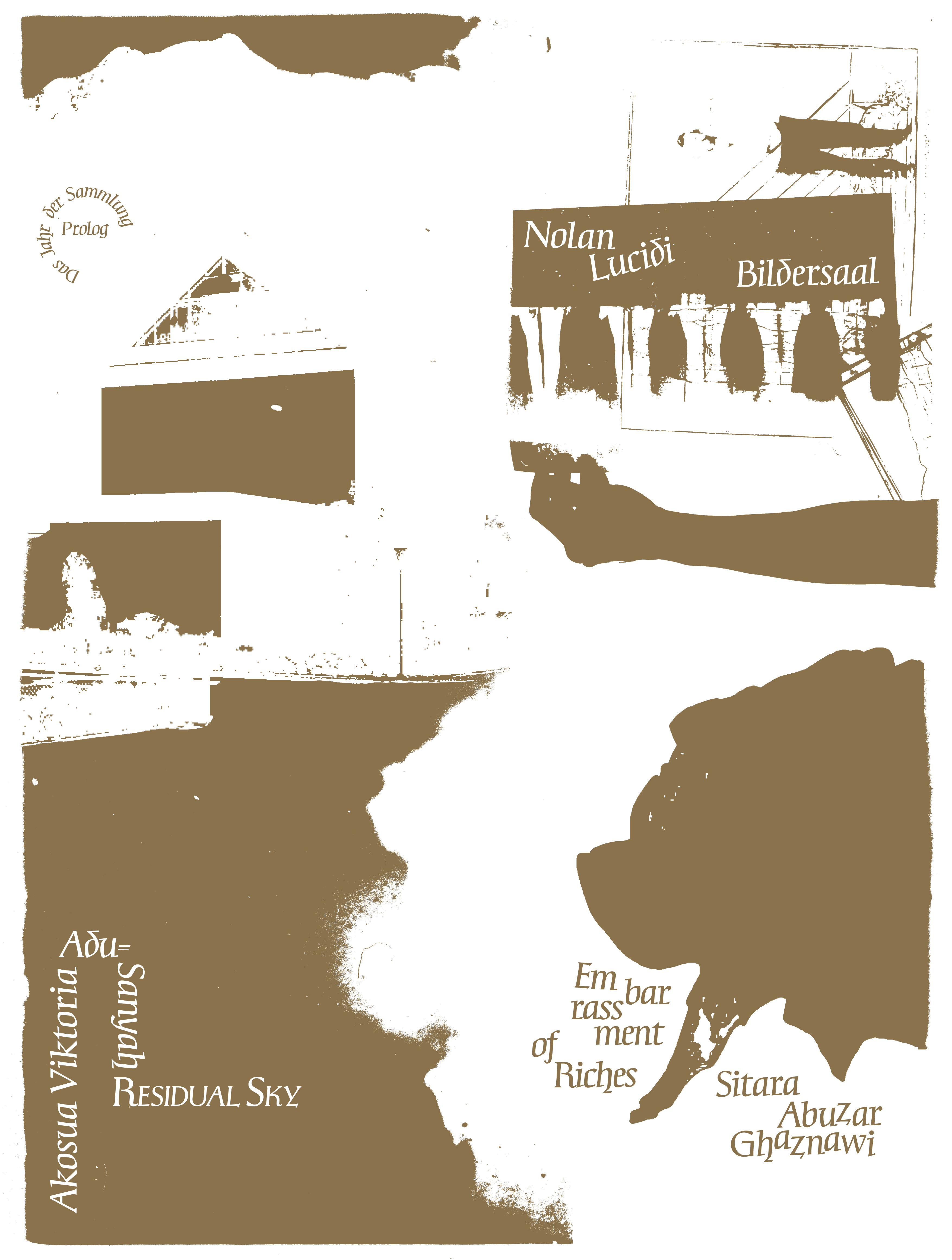
Akosua Viktoria Adu-Sanyah
RESIDUAL SKY
For the first comprehensive institutional solo exhibition of the RESIDUAL SKY group of works, the artist Akosua Viktoria Adu-Sanyah (b.1990, living and working in Zurich) shows a cycle of 13 photographic objects. These consist of large-format, hand-developed, analogue colour photographs on glossy paper, which either hang or stand on white-washed wooden backgrounds in the skylight gallery, attached with magnets. The photographs are based on historical negatives from the British Empire and Commonwealth Collection in Bristol, depicting images from Ghana, the former British colony known as the “Gold Coast”, which is also where Adu-Sanyah’s father was born.
The artist was first alerted to this trove of image material from the British Crown Colonies and Territories in West Africa (1878–1957) in 2024 when she was invited to the Bristol Photo Festival. During her subsequent research she began to take a particular interest in the intermediate spaces in the pictures reproducing the violent hierarchies of the British colonial context, devoid of people. She selected the upper third parts of the pictures—the sky and tree tops—cut and turned them, then bodily adopting them through manual enlargement and development.
In the sense of “residual” as “an internal aftereffect of experience or activity that influences later behavior” (Merriam-Webster), the artist pursues the visible and invisible traces and “residues”—chemical, historical, emotional—that the experience of encountering these photographs have left behind over time. What emerges are images of transition and transformation. The cut-outs of sky and tree tops are no longer part of the landscape (horizontal), but instead become corporeal entities, mirrors, windows (vertical). The intense colourfulness of the photographs evokes a bodily nature—for instance blood, or the red shades left when staring at the sun with ones eyes closed. Or for that matter, the colours over the course of the day. The trees and clouds on the transparent negative film appear like apparitions that confront the here and now. Adu-Sanyah’s works do not insist on a conclusive form; instead they are located in a constant transformational flux, in a continuous meeting between present and absent bodies (including those of the viewers) and different temporalities. The artist works again and again with the same negative, which then adopts varied constellations in new forms of images. One of these insisting motifs reappears in the exhibition: the injured foot of her deceased father—a wound, a patch of colour and a bodily fragment in one.
As opposed to standardised, technically normed production methods in colour photography, Adu-Sanyah works using process-based hand-development techniques, tried and tested in her specially devised darkroom. Her approach is guided by an operational ethic: instead of precisely measurable parameters and serial procedures, the reproductions are produced under conditions that deliberately allow the material, chemistry and environment to play an active design role. The paper is rolled out by hand in the dark; slight discrepancies are consciously kept as part of the picture. Colours and forms are created by filters, improvised tools and through the intrusion of daylight through spatial cracks and openings—not randomly, but as integral factors of an open yet controlled system. Adu-Sanyah shifts colour photography into another realm—beyond mechanical reproduction into a sphere of material and temporal singularity.
Moreover, the time taken to develop the images is determined by the effort and the energy the artist invests in treating the paper and the use of the chemical developer bath, which in turn impacts the definition and the contrast. In this, the artist’s interest lies in a state of “exhaustion”—the constant accentuation of a memory, an emotion or an emulsion to their outer limits, or indeed beyond. And exhaustion in this case also equates with catharsis. What becomes apparent is that the intensity of the process, and indeed the particular beauty of the images that emerge, arises from the persistent search for conditions that allow one to continue living, of life survival. Adu-Sanyah ceaselessly challenges supposed historical and social convictions and fixations in search of an open (visual) scope in which new relationships become possible.
Curated by Annette Amberg.
Akosua Viktoria Adu-Sanyah (*1990, lives and works in Zurich) studied at the Hochschule der Bildenden Künste Saar in Saarbrücken. Her most recent solo exhibitions include: at the Deichtorhallen, Hamburg, the Stadtgalerie Saarbrücken, and no flowers, Centre Culturel Suisse de Paris (all 2026); Hypoxia, Jan Kaps, Cologne (2025); Corner Dry Lungs, Zollamt MMK, Frankfurt am Main, and The House Is A Body, Georgian House Museum and Bristol Photo Festival, Bristol (both 2024); Behold The Ocean, Centre Photographie Genève, Geneva, and May I Dream?, Photoforum Pasquart, Biel (both 2022). Her works have been shown in numerous group exhibitions, including: Alexander Tutsek Foundation (2025); Foam Museum, Amsterdam (2024); Centre de la Photographie, Geneva, and Helmhaus, Zurich (both 2024); Gia Lam Train Factory, Hanoi, Lothringer 13 Halle, Munich, and Kunsthalle Trier, Trier (both 2023). Her works have won various awards, including: the Borlem Preis and Swiss Art Award (2024); with a work grant from the Canton of Zurich and an art scholarship from the City of Zurich (2023); the Louis Roederer Photography Prize for Sustainability (2022); the Prix d’Art Robert Schuman (2021); the Prix Photoforum (2020).
The realisation of the exhibition is made possible by the generous support of: Kanton Zürich