1.3. – 24.5.2026
sitara
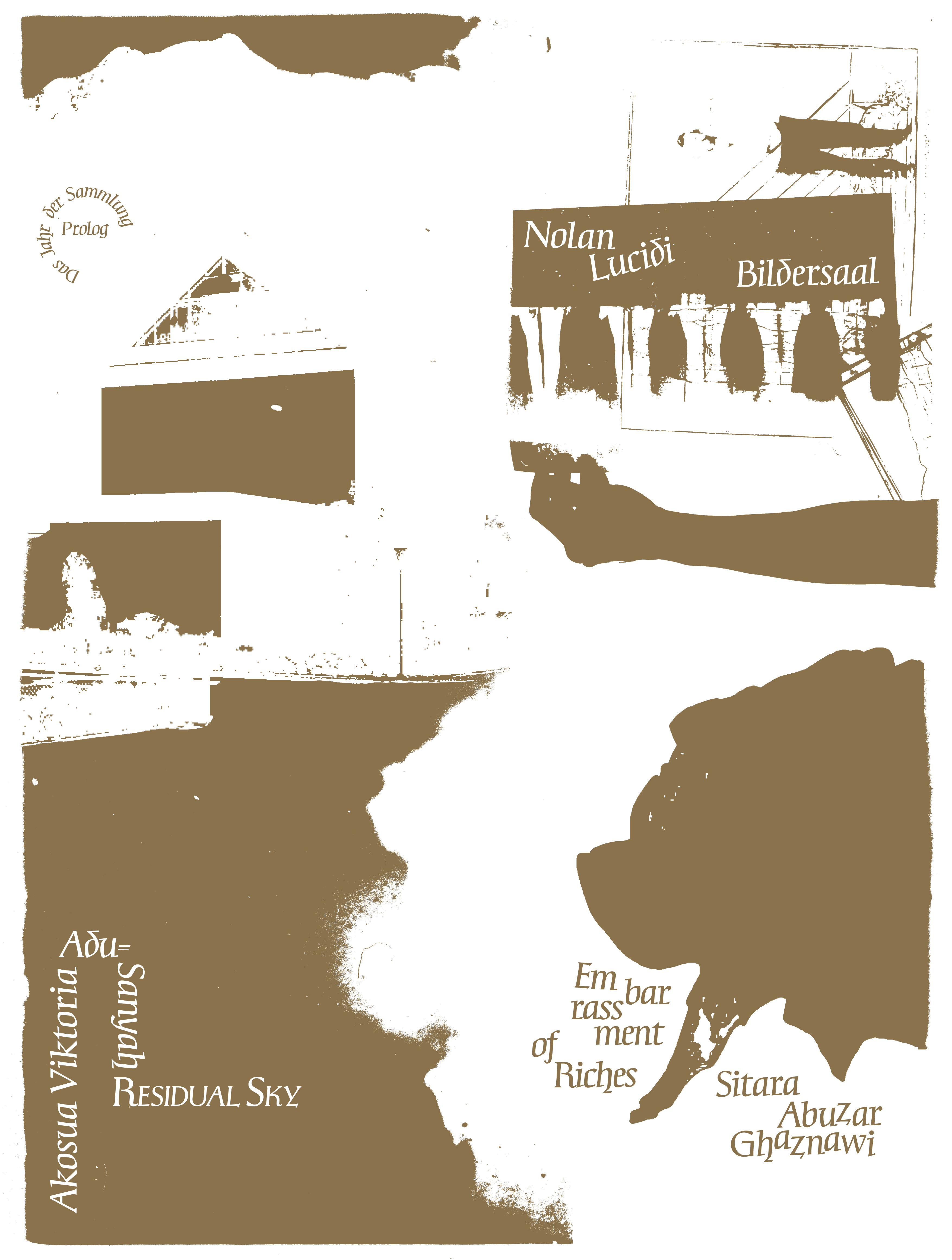
embarrassment of riches
embarrassment of riches is an exhibition of fifty collages featuring pictures of roses, ribbons, trucks, cigarette packets, medicine tablets, blossoms and other nondescript flowers. They are stuck on sheets of paper covered in silver paint, black ink, washed by brushstrokes in shades of green, ochre and blue that resemble the sky and the ground. All works have the same size.
embarrassment of riches could be taken for what it is: an idiomatic expression describing the difficulty choosing in the face of overabundance. Then the exhibition could be construed as a sarcastic posturing where the fifty collages stage a scene of plenty – the riches. It’s anyone’s guess who should feel overwhelmed by such bounty. This reminds me how much of the literature surrounding sitara’s practice presents an oblique stance. The words, regularly written by her close colleagues, have
ranged from rebuffing men eroticising the artist[1] to musing over bookshelves[2], friendship[3], mythical deities[4], and big city promiscuity[5]. An elusive thread emerges through these voices concerning matters of taste. Taste is a finicky term in the global era as it slips through traditional notions of class. In sitara’s case this interpretation is complicated by a xenophobic bias against migrant aesthetics. Does this imply that this exhibition conceals the latest cunning jab at the white establishment? A veiled rebuttal to institutional pitfalls, liberal identitarian politicking, emotional drainage, transnational bureaucracy, diasporic discontent, girlhood, womanhood? Paul Thek used to tell anyone pushing meaning into his work that he was against interpretation. So could we also apply that to sitara, and let a woman just live?
I’m gay and asian – a gaysian. And before you roll your eyes at another faggot waving his freak flag, please hear me out. As a gay person, I relate to the state of emergency in which sitara operates because both of us live under the pressure to integrate, if not outright assimilate. This triggers a constant mediation between our private selves and public personæ. It’s excruciating. No place feels comfortable. No place feels definite. Home is always at an arm’s length, contingent. We learn to catch our breath with less. We find cover in the gaps, those negative spaces incidentally birthed by normative forces. That’s where we train to weaponise institutional speech, tear icons apart and synthesise madness with vitality. That is the threshold where sitara exercises her tactile formalism. For almost a decade, she has been collating the intimate with the rejected: garish fabrics and jewellery chains clash with plastic roses and aluminium surfaces. They signal an implosion of signification that could easily be mistaken for nihilism. Instead, her eclectic bodies of work attest to the liberating quality of composing. To outsiders, compositions are finished documents of expressive restraint, but to makers compositions punctuate a sensuous thought process. They are snapshots of friction. Their legitimacy lies precisely in their errancy, idiosyncrasy and obtuseness. The fifty collages in sitara’s show could equate to fifty crises of the pictorial field. Grass, land, clouds and industry present themselves vague and relaxed. Their coldness centers the austerity of the paper and the artist’s inflections on it. Their very materiality is key, so please stay with it. As sitara tears and refashions the pictorial world anew, I think of collage and its political aesthetic charge. I remember Étienne Balibar’s hypothesis of a politics of violence that doubles as a politics of civility. “The only ‘way’ out of the circle is to invent a politics of violence” he proposes. “In particular, it means introducing the issue of violence and a strategy of anti-violence into emancipatory politics itself.”[6] Like Balibar, I no longer think it’s possible to relegate the phenomenon of violence as something preceding institutions be they cultural, juridical or financial. “Extreme violence is not post-historical but actually ‘post-institutional’. Extreme violence arises from institutions as much as it arises against them.”[7] Thus embarrassment of riches shows fifty shades of a patient negotiation between artistic autonomy, public perception, visual novelty, and poetic absence. There are fifty shades of savviness, delight, wit and elegance, as there are fifty shades of dread, reluctance, chaos and literal waste. There are also fifty shades of objective artworks as well as paradoxes showing how pictures can be so full and yet so deflated, so courageous and yet so defeated, so opaque and yet so transparent, so unique and yet so banal, so rich and yet so…
Bruno Zhu, 2026
[1] Shamiran Istifan and Lhaga Koondhor, exhibition text for LOVE/ terms and conditions, Galerie Maria Bernheim, Zurich, 2021.
[2] Sophia Rohwetter, exhibition text for bookshelf 3, School, Vienna, 2020.
[3] Furqat Palvan-Zade, exhibition text for Hymn and Silence, LC Queisser, Tbilisi, 2021
[4] Shola von Reinhold, exhibition text for Ich kenne Sitara nicht so gut. Sie macht mir wahnsinnige Angst., Shahin Zarinbal, Berlin, 2025
[5] Ian Wooldridge, “WHEN EMOTION BECOMES FORM. A CODE FOR SITARA.” in Simon Castets and Salome Hohl, Emmy Hennings / Sitara Abuzar Ghaznawi (Lenz Press, 2022).
[6] Étienne Balibar, Politics and the Other Scene, trans. Christine Jones, James Swenson, and Chris Turner (Verso Books, 2002), xi
[7] Étienne Balibar, Politics and the Other Scene (see note 6)
The exhibition was initiated by Melanie Ohnemus.
sitara lives and works in Basel and Sarnen. Her most recent solo exhibitions include: I don’t know Sitara that well. She scares the hell out of me, Shahin Zarinbal, Berlin (2025), Sitara Abuzar Ghaznawi & Sem Lala, Forde, Geneva, and Public Sculpture, Amore, Basel (2024); Sin City, Auto Italia, London (2023); Don’t Build Picturesquely (with Marina Xenofontos), Hot Wheels, Athens (2022); Hymn and Silence, LC Queisser, Tiflis, and LOVE/ Terms and Conditions, Galerie Maria Bernheim, Zurich (2021); Emmy Hennings / Sitara Abuzar Ghaznawi, Swiss Institute New York, New York (2020). Her works have been shown in numerous group exhibitions, including at: Galleria Solito, Italy, and CIBRIÁN, Spain (2025); Shahin Zarinbal, Leipzig, and LC Queisser, Tiflis (2023); Antenna Space, Shanghai (2022); Cordova Gallery, Barcelona, yaby, Madrid, and Bernheim, London (2021); Kunsthalle Zürich, Zurich (2020); Fri Art Kunsthalle Fribourg, Freiburg; Galerie Maria Bernheim, Zurich, Messe Basel, Basel; Museum im Bellpark, Kriens, and Édouard Montassut, Paris (2019).
The realisation of the exhibition is made possible by the generous support of: Kanton Obwalden, Stiftung Erna und Curt Burgauer, Kunstkredit Basel-Stadt, Landis & Gyr Stiftung, Hans und Renée Müller-Meylan Stiftung, Niarchos Foundation for Young Artists