19.9. – 22.11.2026
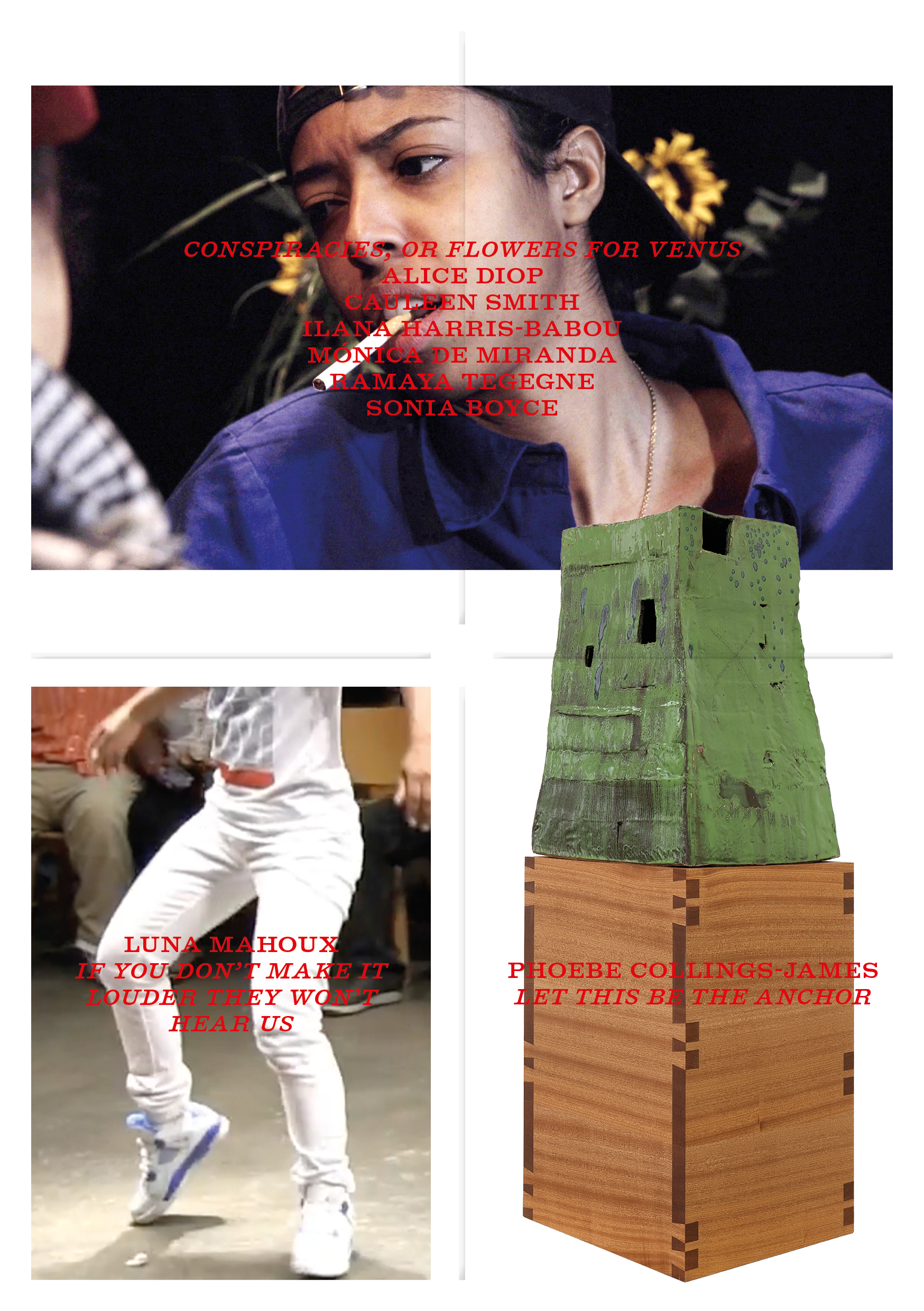
Conspiracies, or Flowers for Venus
With Alice Diop, Ilana Harris-Babou, Mónica de Miranda, Cauleen Smith, Ramaya Tegegne, Sonia Boyce
Convened by Greg de Cuir Jr
It started with the award-winning narrative poem Voyage of the Sable Venus (2015) by Robin Coste Lewis, which is constructed out of fragments of a lengthy history of titles and descriptive texts related to representations of the Black female figure in Western art. This layered collage of charged metadata is alternately beautiful and horrifying, as it narrates a centuries-long campaign of ideological and aesthetic oppression of Black women in which art is not a witness but an active participant. Lewis’ poem includes not only colonial-era representations but also the titles and synopses of twentieth century works of art made by Black women, and as such points towards a decolonial present in which narratives are written by those who have traditionally been submitted to the weight of Western hegemony. This rigorous and radical gesture shed a guiding light on the conception of the exhibition Conspiracies, or Flowers for Venus.
When Annette Amberg, Director of Kunsthaus Glarus, invited me to assemble a selection of films and videos that would be shown in the institution’s galleries she also noted that she was planning two solo exhibitions, one with Phoebe Collings-James, a London-based artist who works with ceramic forms, and the other with Luna Mahoux, a Brussels-based artist who works with digital images sourced from social media. Annette proposed that the selection of films and videos could enter into conversation with this exhibition, which sparked a dialogue between us about recent moving image practices that captured our imaginations.
Some of the most exciting work I knew in recent years has been created by an international and multi-generational community of Black femmes in contemporary art. These are films and videos which arose in the period immediately following the latest artworks included by Robin Coste Lewis in her poem, and as such have not yet been canonised, though their makers have received awards and accolades for careers that are ascending. Annette sent me Luna Mahoux’s first short documentary The Other Queen of Memphis (2025) shortly after our initial conversation, a lyrical portrait of the hiphop artist La Chat. This loving tribute to and celebration of an underappreciated performer further inspired and solidified the impulse to pay homage to the Black Queens of the moving image. The dialogue between the three exhibitions thus runs in a multilateral fashion, spanning generations and geographies, also poetics and politics.
Conspiracies, or Flowers for Venus is an anthology comprising an international cohort of Black femmes who have distinguished themselves in their virtuosity with the moving image, alongside their other practices.
Cauleen Smith’s video Home Girls (2024) is an adaptation of the book Home Girls: A Black Feminist Anthology (1983), edited by Barbara Smith. Cauleen Smith reads aloud the names and biographies of the various contributors to this capital volume, some of whom are among the most accomplished of all Black women of letters, such as Audre Lorde and Alice Walker. As Cauleen Smith pronounces these dedications she places a unique flower into a bottle as a tribute for each named woman, resulting in a monument of stunning beauty that merges the organic with the handmade. The entire video is executed in a single take, as part of Smith’s ongoing series of studies in economy and improvisation staged inside of her studio.
Alice Diop’s film Fragments for Venus (2025) is another kind of adaptation. The film takes direct inspiration from the poem Voyage of the Sable Venus by Robin Coste Lewis. Diop opens the film by placing a modern-day Venus inside of a grand museum where she examines some of the works of art and descriptions featured in the poem, before taking a voyage through the streets of New York City and devoting a loving cinematic gaze to Black women of all ages, shapes and colors. Diop calls this her “most simple and radical work to date”, and that it is “meant to make people talk.” As such, the work is completed by you, dear viewer.
Ramaya Tegegne’s video Framer Framed (2021) unfolds as a dramatisation of a meeting between the managers of an unnamed independent cinema in Geneva. They are facing a dilemma about how to react to a situation in which African migrants were ejected from the lobby of their cultural institution with the questionable charge of loitering. Their ethical conundrum is situated in the fact that on the same evening they were projecting a film about African migrants and the lack of care they are afforded in European society. Tegegne’s film is presented in the shape of a theatrical drama, but shot in a cinema as the main stage, with performers who are actual artists and cultural workers. The piece lands a devastating critique of cultural management and the supposed radicality of those who operationalise engaged art – including the audiences who consume it. Everyone is framed.
Ilana Harris-Babou’s video Leaf of Life (2022) returns us to the world of flora. This time the flowers are devoted to a man: the herbalist Dr Sebi, who advocated for a healthy diet of natural foods that complemented the African gene structure. Through bright colors and lively animation, along with her sly sense of humor, Harris-Babou explores the mythology of a man who attracted a global following, but who suffered from charges of fraud shortly before he died. The video indulges in the lovely hues and textures of fruits and vegetables – a celebration of the very material sources that sustain life. As the artist remarks in the video, referencing the Book of Revelations: “To eat of this tree would be to die no more.”
Mónica de Miranda’s video Transplanting (2024) deposits the viewer into multiple variations on Edenic gardens: the Botanical Garden, natural forests, and urban gardens of Lisbon. Each of these green spaces carries ideological weight, whether in the form of an overbearing coloniality or radical acts of care. The video features dancers performing in these spaces, intertwining themselves with their floral counterparts, laying claim to a rooted knowledge. De Miranda often explores natural ecosystems in her work, with Creole gardens taking privileged positions as anticolonial ideal. After all, the seeds of liberation belong to an interspecies commons.
Sonia Boyce collaborated with sound artist Ain Bailey to make the video Oh Adelaide (2010), an abstract portrait of the pioneering jazz singer Adelaide Hall. Archival footage of Adelaide performing on stage is expanded to conceptual points beyond the film frame by an ethereal glow that consumes the image. This visual play of overexposure pushes Hall into another plane of existence, both inside and outside of history, as Boyce describes it. Bailey’s experimental soundtrack is composed of re-worked audio recordings of Hall singing in her unique, wordless scat technique. Visual abstraction finds its complement in musical abstraction here, and the resulting work is both challenging and sublime. This ode to Adelaide is a tribute to a Black creative force who forged a new path and led the way for a Sonia Boyce and an Ain Bailey to arise some decades later, along with subsequent generations of brilliant Black femmes of musical arts, visual arts, and cinematic arts.
(Text by Greg de Cuir Jr)
Short biographies
Alice Diop (* 1979, lives in Noisy-le-Sec) is a French film director and screenwriter. In her work, Diop examines society from the margins and strives to give space to unique life stories — by focusing on the intimate, she explores the universal. With a deliberately understated yet uncompromising visual language, she addresses themes such as identity, migration, and colonialism. She transforms personal stories into political imagery with a focus on observations of representations of Black life.
Cauleen Smith (*1967, lives and works in Los Angeles) is an interdisciplinary artist whose work reflects everyday possibilities of imagination. Influenced by historical politically engaged cinema, by feminist and Afrofuturist movements, as well as by jazz, poetry, discourse, and literature, Smith combines film with a range of artistic media and experimental forms of storytelling. She questions and expands upon dominant forms of Western knowledge systems, countering them with alternative worlds of imagination and future scenarios rooted in Black culture and the experience of the Afro-diaspora.
Ilana Harris-Babou (*1991, lives and works in NYC) works around her fascination with aspirational lifestyles and the many pillars of civilized, bourgeois, and largely white femininity.
The Portuguese visual artist Mónica de Miranda (*1976, lives and works in Lisbon and London), photographer, filmmaker, and researcher of Angolan ancestry, is known for her work on socially inspired themes, including postcolonial issues of geography, history, and subjectivity related to Africa and its diaspora. Her interdisciplinary and research-based practice critically looks at the convergence of politics, gender, memory, space and history. She is the founder of Hangar (2014), an art and research centre in Lisbon that provides spaces where artists, curators and researchers, mainly from the global south, can co-create and build social and creative networks to benefit their communities.
Ramaya Tegegne (*1985, live and works in Geneva) is an artist, researcher, and cultural organizer. Her transdiciplinary practice addresses the processes by which the field of art is constituted by investigating its dominant and structural mechanisms. Tegegne seeks to amplify collective struggles, challenge the status quo and foster mutual self-defense against institutions. She examines the power relations, narratives, selection and production conditions of art and culture in the current context. In 2017 she launched the campaign Wages For Wages Against, acting for better working conditions for artists and an alternative economy of the arts.
Sonia Boyce (*1962, lives and works in London), is an interdisciplinary artist and academic working across film, drawing, photography, print, sound, and installation. Boyce creates immersive and experiential spaces that explore themes of play, disruption and revelation in which the audience become active participants. She continues to break new ground through her commitment to questioning the production and reception of unexpected gestures, with an underlying interest in the intersection of personal and political subjectivities.
Greg de Cuir Jr (lives and works in Belgrade)is co-founder and artistic director of Kinopravda Institute in Belgrade. A part of his work is concerned with visual representations of Black culture in its various complex forms. With a focus on the intersection of avant-garde cinema, the politics of the Black image, and the excavation of overlooked regional histories, he has organised exhibitions and programs for Whitney Museum of American Art, Institute of Contemporary Arts in London, Hauser & Wirth, Frieze, National Gallery of Art in Washington DC, e-flux, Locarno Film Festival, Videoex Zürich and other institutions. His writing has been published in Ursula, CURA., Cineaste, Millennium Film Journal and other journals, and in anthologies and catalogs for Centre Pompidou, Hammer Museum, Institut Valencià d'Art Modern and others.