19.9. – 22.11.2026
Phoebe Collings-James
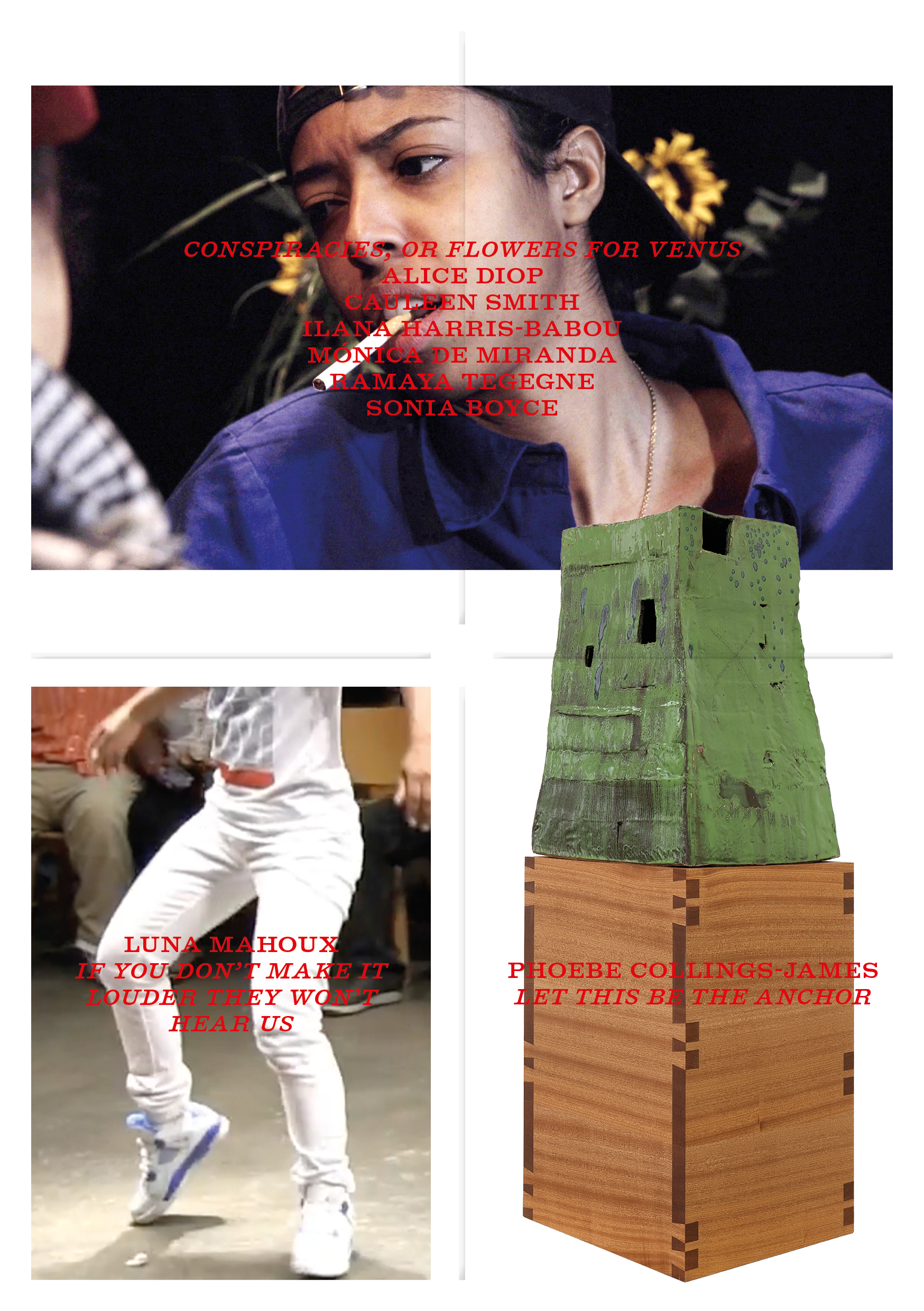
Let this be the anchor
With Let this be the anchor, Kunsthaus Glarus – in cooperation with KH Künstler:innenhaus Bremen – presents Phoebe Collings-James’s first solo exhibition in Switzerland.
Phoebe Collings-James (*1987, lives and works in London) explores forms of vulnerability and fragility in her artistic practice, as well as those remnants and fragments of histories and stories that cannot be told linearly. She often finds these in her work with clay, a malleable yet not entirely controllable material. The resulting works function, as she writes, as “emotional debris,” speaking to what emerges in moments when social orders begin to disintegrate. The solo exhibition Let this be the anchor is thus both a form of taking stock and a means of orientation.
For her most recent body of work, consisting of seven ceramic sculptures with wooden and brass elements, Phoebe Collings-James investigates the material and social space between stability, collapse, and reconstruction. The sculptures emerge from her observations of architectural structures and traces of social life in public space, as well as the ways in which these are organised and constrained. Stories of violence and inequality, but also of intimacy, sensuality, and calls for resistance, are inscribed into their surfaces—through incised words, signs, and symbols, as well as through the manipulation of the clay itself. Situated somewhere between abstract form and architectural model, each sculpture contains a potential for movement and transformation—not only on a symbolic level, but also in the material reality of the work itself.
Clay responds to pressure while shaping it, and during the drying and firing processes it can warp, crack, or break. For Phoebe Collings-James, these conditions are not limitations but an integral part of the process of finding form. Unlike in her earlier works, for Let this be the anchor she did not use the coiling technique to develop rounded vessels but instead worked with flat strips of clay. The resulting bodies, constructed from basic geometric forms, are rudimentary architectures that take the tower as their leitmotif, evoking high-rise buildings, abandoned spaces, the watchtower, enclosures as well as shelters and dwellings. Both in the process of making and when moving through the exhibition, the tower appears not only as an architectural object with the character of a model, but also as a conceptual figure representing elevation and orientation, as well as fragility and the potential for disruption. The tower is one of the oldest and most polyvalent figures in the collective visual imagination: a symbol of power, utopia, and threat all at once. As a sign of stability and growth, and as a representation of power through its monumental form in urban space, it also always contains the possibility of collapse.
Running parallel to this is a quieter narrative, emerging through a series of more intimate gestures that also reveal the supposed tower as a carrier: a carrier of messages of resistance (“Freeeee”), urgency (“land back”), but also a pedestal for roots and small figurines formed from clay that may have a ritual character. Here, Phoebe Collings-James also makes poetic and subtle reference to the cultural and political significance of Black, queer, and feminist traditions of radical thought, and to the importance of connecting to existing traditions of knowledge and thinking. Thus, within an apparent instability, an order becomes visible—one that can be read as a network of many interwoven stories and perspectives. These intersect in complex ways, forming an image of individual and collective identities that is at once strong and mobile. It is an understanding of community in the sense of Patricia Noxolo’s concept of the fractal (“Caribbean In/Securities: An Introduction”). Unlike the term “fractured,” which suggests rupture and destruction, the fractal refers to recognisable patterns that repeat themselves across different levels. In this sense, the exhibition addresses questions of protection and resistance by bringing architectural, material, and emotional fault lines into relation with one another.
This text is an adapted version of the exhibition text for KH Künstler:innenhaus Bremen, where Phoebe Collings-James’s works were on view from June to August 2026.
Phoebe Collings-James (*1987 in London, GB, lives and works in London) completed her studies in Fine Art at Goldsmiths College in London. Exhibitions: Spike Island, Bristol (upcoming), Künstler:innenhaus Bremen (2026), Pitzhanger Manor & Gallery, London (2026), Albuquerque Foundation, Sintra (2026), KINDL Berlin (2025), Mendes Wood, Brussels (2025), Sculpture Center, New York (2024), arcadia missa, London (2024), Camden Arts Centre, London (2021), Picture Room, New York (2021), Palais de Tokyo, Paris (2020), Ginerva Gambino, Cologne (2020). Her ceramics studio Mudbelly began as a personal research project but has since grown into a shop and teaching platform that offers free ceramics classes for Black people in London, taught by Black ceramicists.